
SMU Duke-NUS Mobile Sensing Study
Leveraging Mobile Sensing to Provide Early Detection of Meltdowns in Children with Autism
While the Autism Collaborative may promote or share information about research projects conducted by other organisations, such promotion does not constitute an endorsement or representation of those organisations, their views, or their work.
The Autism Collaborative is not responsible for the content, conduct, or outcomes of such studies. Our role is limited to facilitating awareness of opportunities that may be of interest to the community.
Please contact the respective organisations for more information about their research programs.
If you have participated in any of these research projects and would like to share your feedback, or if your organisation wishes to have a research project listed, please reach out to us at imh.autism.research@nhghealth.com.sg.
Our organization reserves the right to remove any research project listed without any prior notice.
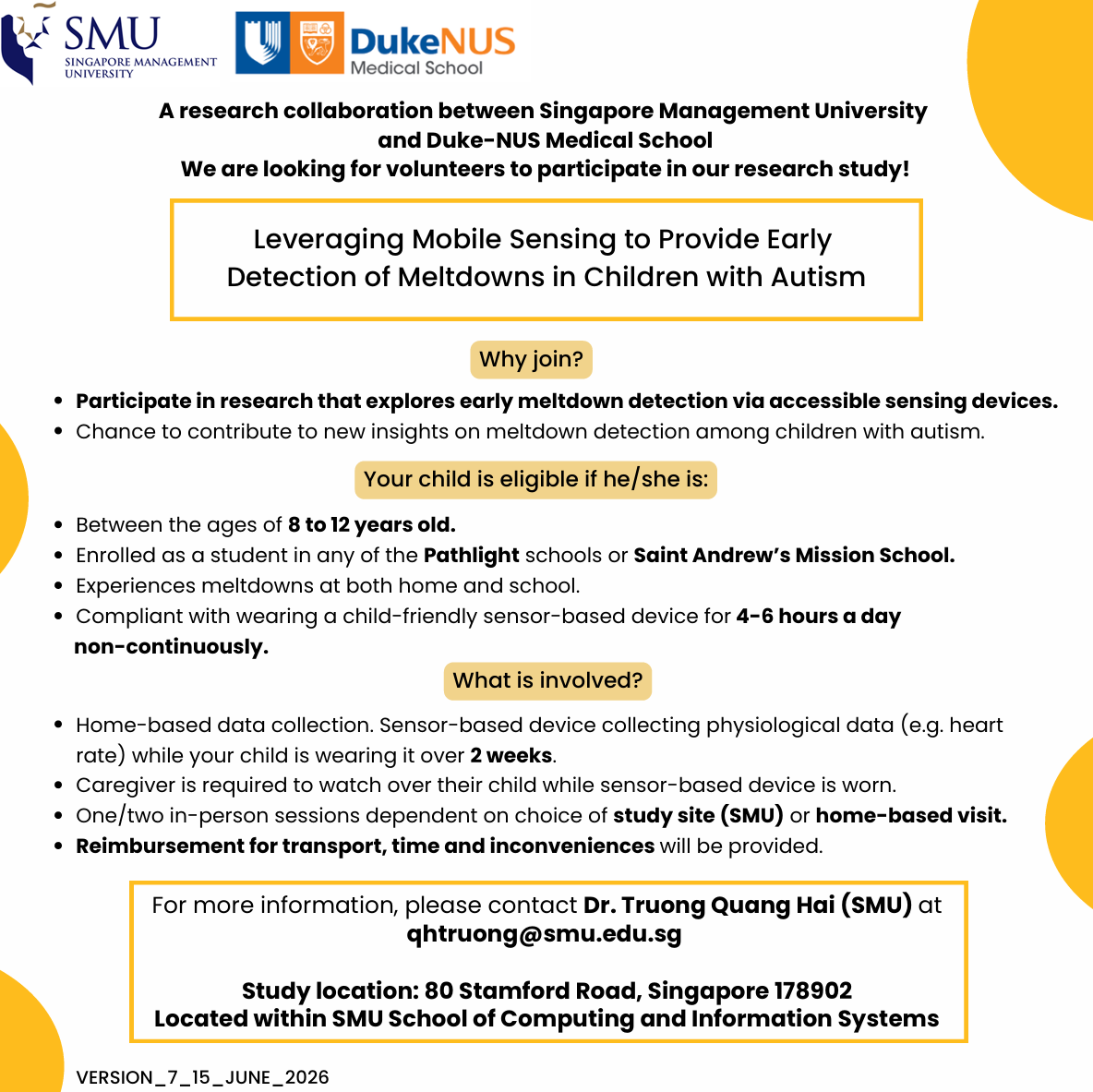
Leveraging Mobile Sensing to Provide Early Detection of Meltdowns in Children with Autism
Are you interested in contributing to research exploring early detection of meltdowns in kids with autism? 💭
A research team collaboration between Singapore Management University (SMU) and Duke-NUS Medical School is leading an exploratory study aimed at using existing sensor-based devices to detect meltdowns. A meltdown is an intense outburst, typically when a person with autism experiences overwhelming emotions. They are recruiting 8-12 years old participants with autism, enrolled in Pathlight or Saint Andrew's Mission School, and their caregivers for a home-based research study. To be eligible, participants must experience meltdowns and be comfortable wearing a child-friendly smartwatch for 4-6 hours a day in flexible intervals. Reimbursement for transport, time and inconveniences will be provided. More information can be found in the poster above.
If you are interested, please reach out to Dr. Truong Quang Hai (SMU) at qhtruong@smu.edu.sg